
Understanding the Australian WHS Framework
The WHS Framework
If you are responsible for inspecting playgrounds, or you want to offer playground inspection as a professional service – you are operating inside a structured legal and regulatory environment. Understanding how that environment is layered shapes your duties, your liability, and what qualifies as a competent inspector.
Australia’s Work Health and Safety (WHS) framework is built on a clear hierarchy. Each layer reinforces the one above it. Get familiar with each level, and you will understand exactly where playground safety standards and inspections fit and why training and certification matter far more than a site inspection with a checklist or auditing app.
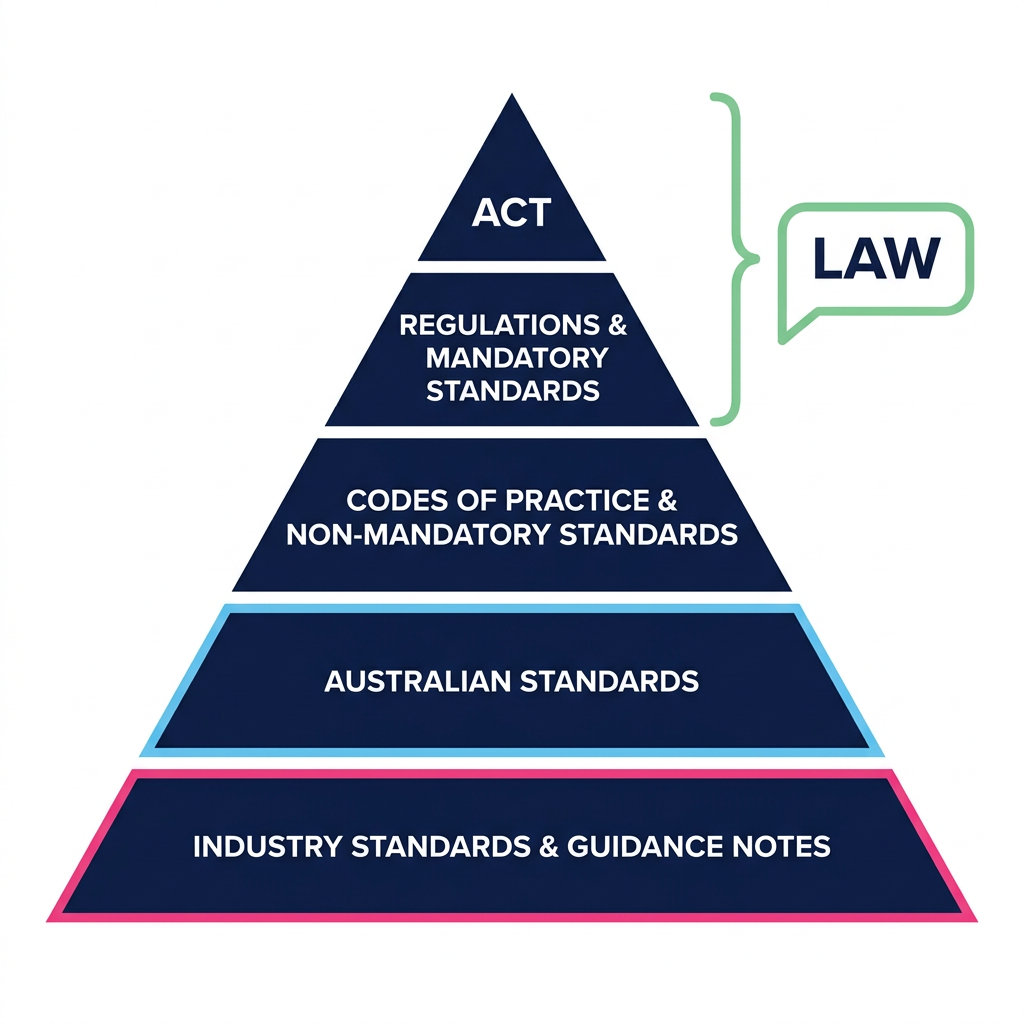
Figure 1: A WHS framework hierarchy pyramid, highlighting in green where the ACT and regulations & mandatory Standards apply as Law. Highlighting in blue the Australian Standards and pink other industry Standards and Guidance notes.
Layer One: The WHS Act
At the top of the framework sits the legislation (law).
In 2011, Safe Work Australia developed model WHS laws intended to create consistent workplace health and safety obligations across the country. To become legally binding, each state and territory must separately enact those model laws through its own parliament. Safe Work Australia maintains the model laws and provides national guidance, but it does not regulate or enforce – that responsibility sits with each jurisdiction’s WHS regulator.
This means that while the WHS framework is largely harmonised across Australia, the specific regulator you are answerable to depends on where you are operating. A full list of state and territory WHS authorities is available at https://www.safeworkaustralia.gov.au/law-and-regulation/whs-regulators-and-workers-compensation-authorities-contact-information.
The Act establishes broad duties: the obligation to ensure, so far as is reasonably practicable, the health and safety of workers and others affected by the work. For playground inspection, “others” includes the children/site visitors using the equipment.
Layer Two: WHS Regulations
Below the Act sit the Work Health and Safety Regulations 2011. The Regulations do the detailed work: they specify how duties must be carried out, set procedural and administrative requirements, and define what is required to support the broader duties in the Act.
Where the Act sets the principle, the Regulations set the practice.
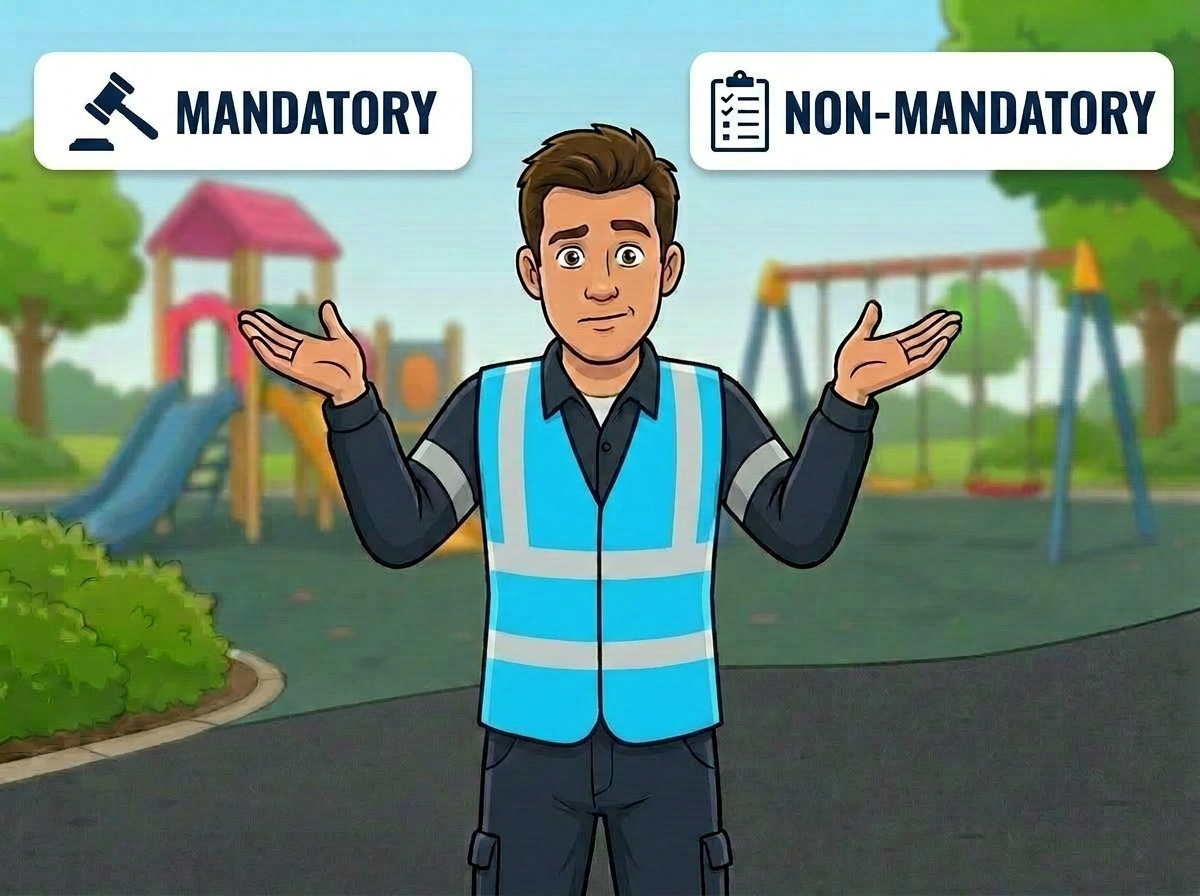
Layer Three: Codes of Practice and Non-Mandatory Standards
Codes of Practice are practical guides to help duty holders achieve the standards required under the WHS Act and Regulations. They are not legislation, but they carry significant weight where a court or regulator may refer to a Code of Practice as evidence of what is reasonably practicable.
Layer Four: Australian Standards (AS) 4685 and AS 4422
This is the layer most directly relevant to playground inspection practice.
Australian Standards are published documents that set out specifications and procedures to ensure products, services, and systems are safe and consistently perform as intended. They establish minimum requirements and define quality and safety criteria.
Critically, Australian Standards are developed by consensus: they are voluntary… But many are adopted into legislation or referenced in contracts, at which point they become mandatory in that context.
AS 4685 Parts 0 through 6 and AS 4422 is the primary Australian Standard for playground equipment and surfacing. If you are conducting a playground inspection, AS 4685 and AS 4422 is the technical framework your work is measured against. Clients may expect it. Regulators may reference it. Contracts may specify it.
Knowing that this Standard exists is not enough. Competently applying it requires structured training and practical understanding of its requirements across all relevant parts.
Layer Five: Industry Standards and Guidance Notes
The base of the hierarchy is occupied by industry standards and guidance notes developed by professional associations, regulators, and industry bodies to provide practical, operational guidance on specific hazards and risk management approaches.
The Essential Safety Manual Guide for Playground Safety (Operators Module) from Play Safe Institute is a good starting point when it comes to our industry bench-marking and guidance notes. From there, our training and certification pathways take you through the technical depth required to inspect with authority and confidence.
Why Playground Inspectors Need Formal Training & Certification
What “Certification” Actually Means in This Industry
In the context of playground safety inspections, the word “certification” is often used loosely. It is worth being precise about what it actually means and why it matters legally as well as professionally.
The Australian Standard AS 4685 Part 0 (2017) defines a competent person as:
“A person who has acquired through training, qualifications or experience, or a combination of these, the knowledge and skills enabling that person to perform a specified task.” – Clause 5.1, Australian Standard AS 4685 Part 0, 2017, Page 6.
This definition is the foundation on which inspection work rests. In the context of playground safety, a competent person is someone who possesses the necessary skills and expertise to assess playground equipment, identify hazards, and ensure compliance with Australian Standards. It is not a matter of general experience or good intentions: it is a matter of demonstrated, structured competency.
Certification from Play Safe Institute is the recognised pathway to meeting this definition. It is not simply a credential to list on a resume: it is the professional and legal baseline that distinguishes a competent inspector from someone who simply walks around a playground and makes judgements based on their understanding. Without formal certification, an individual cannot credibly claim to meet the AS 4685 standard for competency, and in the event of an incident, that gap becomes highly significant.
Read our other blog referencing the Standards and competency definitions
When It Goes to Court and Why Standards Are Non-Negotiable
When a playground injury or incident results in legal action, the Standards are called upon as the objective benchmark across the entire lifecycle of the playground – from design and manufacturing through to installation, maintenance, and refurbishment. They represent what a reasonable, competent professional was expected to know and do.
The inspection phase is no exception. Inspectors are expected to reference the Standards at all times during their work. Failing to do so, or failing to demonstrate that you did, creates serious legal and professional exposure for the inspector and for the organisation they represent.
Courts and regulators treat the Standards as the objective measure of reasonable practice. If an inspector’s methodology cannot be shown to align with those Standards – through documentation, structured assessment criteria, training, qualification and/or experience – their conclusions carry significantly less weight. More importantly, their conduct becomes harder to defend.
Case study-example
A picture of a piece of equipment with no references or the only reference “In working order” for example and/or no additional close up image evidence in the report or appendix/file storage, is not a defensible position when a Standard and industry bench-mark expectation exists. These responses may reflect genuine experience and good faith, but they do not meet the bar that Australian law and the Standards themselves require. The existence of AS 4685 means that the expected approach is documented and publicly available. An inspector who is not working to that framework has no meaningful defence against an allegation of negligence.
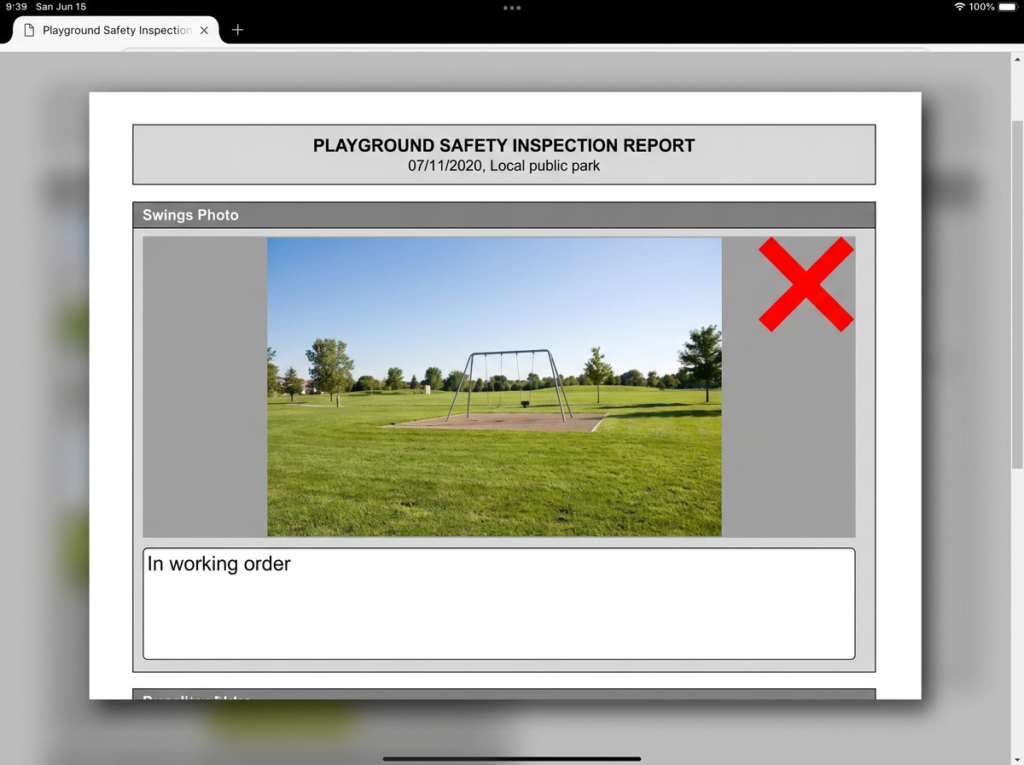
Figure 2: example of an incompetent and untrained inspector report given to Council by a contractor which is not acceptable as an industry bench-mark.
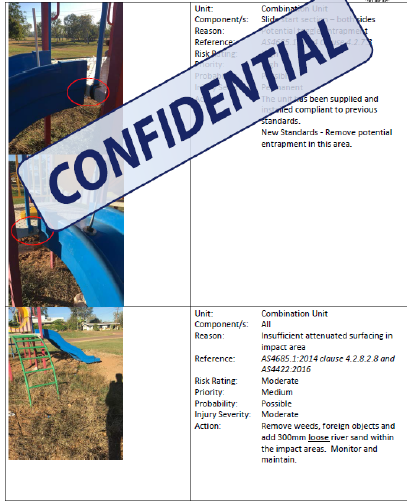
Figure 3: Example high-end report from a Trained and Certified Level 3 Comprehensive Playground Safety Inspector. Attention features such as reason for reporting, reference to the relevant Standard clause number/s, a risk rating (referenced in their Appendix), a priority and probability rating and recommended actions for playground owner and operators to meet compliance. Their photo evidence includes close up and multiple angles with extra visual aid using red circles for important viewer attention and action.
This is precisely why documentation, structured methodology, and certified training matter – not just for compliance, but for legal protection. They create a clear, auditable record of what was done, how it was done, and on what basis. That record is the difference between a defensible outcome and a costly one.
The Gap Between Checking a Playground and Being a Competent Inspector
WHS legislation uses the term “competent person” with legal meaning. A competent playground inspector must be able to:
- Identify operator requirements and applicable regulatory and standards obligations
- Assess and manage equipment registers
- Conduct structured, methodical inspections across all equipment types and surfaces
- Recommend corrective actions with appropriate documentation
- Manage maintenance procedures and records
- Handle incident records in a way that supports duty of care obligations and legal accountability
When you offer playground inspection as a professional service, you take on a duty of care. That duty is not discharged by a site visit and a general observation. It is discharged by systematic, competent, documented inspection practice – carried out by someone formally trained and certified in that work.
Why Formal Training and Certification Matters
Playground inspection sits at the intersection of every layer of the WHS framework. A competent inspector needs to understand the Act’s broad duties, apply the Regulations correctly, work within relevant Codes of Practice, and be technically proficient in AS 4685 and AS 4422 across all parts.
That is not a skill set you acquire informally.
Play Safe Institute provides exactly that. With trainers who bring decades of internationally recognised expertise, we deliver comprehensive training covering playgrounds, surfacing, shade structures, parkour, skatepark, and outdoor facilities. Flexible delivery: in-person, live stream, and online which means you can access quality training per any restrictions or requirements you may have.
Certification through Play Safe Institute positions you to operate with confidence across all layers of the WHS framework: legally informed, technically competent, and professionally credentialed.
Ready to take the next step? Click here to explore training options, certification pathways, and upcoming course dates. Operating in the playground safety space without formal certification is a risk to your clients, your professional standing, and your legal position. Training with Play Safe Institute removes that risk and gives you the credentials to back it up.