
Showing What You Know: How Level 3 Students Can Demonstrate Competency Without a Full Toolkit
Not every student who enrols in Level 3 playground inspector training has immediate access to a complete inspection toolkit. If that is where you are right now, you are not alone and it does not have to stand in the way of demonstrating your competency and progressing through your assessment – a toolkit is not required to complete our Level 3 training.
Here is what you need to know.
Evidence Gathering Is a Valid, Recognised Assessment Method
In recognised training and competency-based assessment, demonstrating that you understand a concept and can apply it in practice does not always require the physical tool in hand. Evidence gathering is a formal, recognised method of showing competency, and when it is done well, it paints a clear picture of your knowledge and your ability to apply it.
For Level 3 students, evidence-based assessment might look like:
- Photographs with written observations: images of playground equipment or surfaces annotated to show what you are looking at, what concerns you, and why
- Written inspections and observation notes: structured notes that walk through a task the way a certified inspector would, demonstrating your understanding of the process
- Checklists completed from site observations: working through an inspection checklist methodically and recording your findings in detail
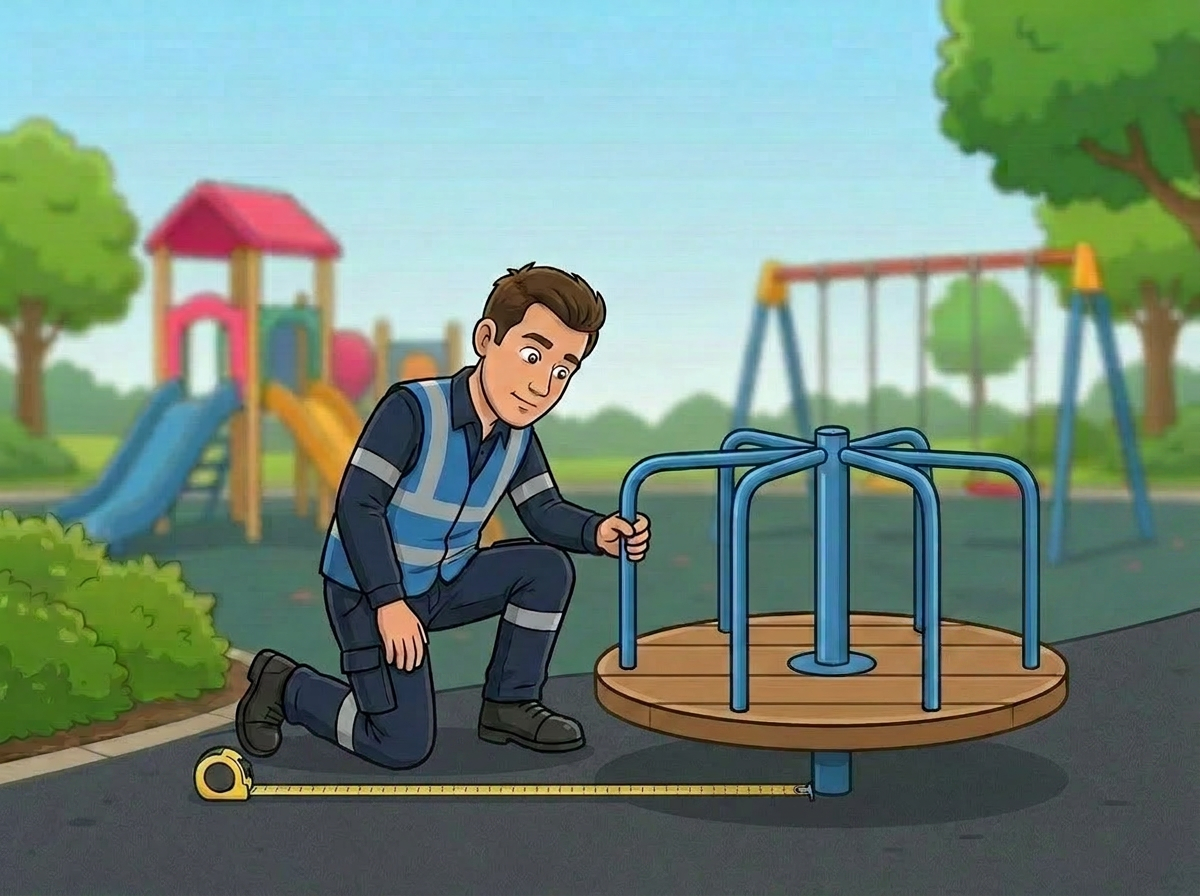
- Measurements using alternative methods: where a specific gauge or probe is unavailable, demonstrating the principle using a clearly documented alternative (e.g. noting what measurement would be required, what acceptable tolerances apply, and what outcome you observed)
- Diagrams and sketches: hand-drawn or digital diagrams showing equipment configuration, fall zones, impact areas, or other spatial measurements
- Witness statements: a statement from a supervisor, employer, or qualified inspector who observed you performing a related task
- Annotated reports: existing inspection reports that you have worked through, adding your own annotations to explain what the findings mean and what action would follow
- Reflective journals: written reflections on your learning, including what you observed on a site visit, what you noticed, what questions it raised, and how it connects to the standards
The key is quality and depth. Evidence that clearly shows you understand the task, why it matters, what you are looking for, how the standard applies will carry weight in your assessment.
Putting It Into Practice: Relatable Examples
Working with probes and gauges in your documentation: Head, neck, and torso probes test for entrapment risks – a critical safety concern. Without the physical probes, you can demonstrate competency within our CIPGL3 Assessment 3 Level 3 Comprehensive Inspection Report by identifying a potential entrapment hazard from a tape measure and photographs, referencing the relevant dimensions in the standard, and documenting how you would conduct the check if the probe were available and what outcome you would need to see. This shows you understand the principle, the risk, and the process.
Toggle entrapment: using the Standards you can find the chain link length and size, this is available at most local hardware stores. Toggles are available on some clothing you might find around your home, mimicking the real-world examples of how toggles can cause entrapments and potential hazards.
Important: Evidence Is for Assessment, Not for Real-World Inspections
Evidence-based demonstration of competency is an assessment tool. It exists to help you show what you know and to support your learning journey. It is not a substitute for conducting actual playground inspections.
Once you are a certified and practicing Level 3 Playground Inspector, the expectation is clear: you use the specific tools and equipment referenced in the Australian Standards (AS 4685 Parts 0, 1-6, 14 and AS 4422). Those tools exist for a reason. Impact testing, entrapment checking, surface depth measurement, and equipment stability assessment all require accurate, repeatable results and that requires the right equipment.
Best practice is non-negotiable in the field. Every playground inspector on the register has a responsibility to the children who use those spaces, to the organisations they work for, and to the integrity of the inspection process. Cutting corners with equipment in a real inspection is not an option.
Use your time as a student to understand the tools deeply: what they measure, why each test matters, and what the standard requires. That understanding, combined with the correct equipment, is what makes a great inspector.
You Are Building Toward Something
The goal of your Level 3 training is not just to get through an assessment – it is to develop real, transferable expertise that keeps children safe on playgrounds across Australia.
If you are gathering evidence right now because you do not yet have the full toolkit, focus on depth and quality. Engage with every task as though you were on-site with the full kit. Document your reasoning. Reference the standards. Ask questions. The understanding you build now will translate directly into the work you do as a qualified inspector.
When you are ready to invest in your toolkit, PSIA.NET.AU can guide you on what is included and how to use each piece of equipment in the field. In the meantime, keep building your evidence matters.
Play Safe Institute offers Level 1, 2, and 3 playground inspector training across Australia, covering AS 4685 Standards (Parts 1–6, 14) and AS 4422 with flexible delivery options including on-site, live stream, and online learning. For more information, visit playsafeinstitute.com/courses.