
Whilst playground safety inspectors focus primarily on equipment compliance and fall zone requirements, a growing operational challenge faces facility managers across Australia: drug-related contamination in public play spaces. This issue intersects workplace health and safety obligations, risk management protocols, and community safety considerations that extend well beyond traditional playground inspection frameworks.
The Scope of the Problem in Australian Public Spaces
Drug-related debris in playgrounds and skateparks represents a significant public health concern. A scoping review published in the International Journal of Drug Policy identified that needle debris and discarded drug paraphernalia in community settings, including parks and playgrounds, pose direct injury risks and psychological impacts on communities (Ti et al., 2023).
Victorian research examining public space drug use found that individuals who inject drugs often seek secluded public areas, including playground facilities during off-peak hours, due to lack of safe alternatives and fear of detection (Dovey et al., 2001). This behaviour pattern creates predictable contamination risks in spaces designed for children’s play.
The Crime Prevention Victoria guidelines for safer skateparks specifically acknowledge that antisocial behaviour, including drug use, represents one of the primary management challenges for these facilities (Crime Prevention Victoria, 2021). Unlike traditional playgrounds with defined age groups, skateparks attract diverse user demographics and extended operating hours, increasing exposure risk.
Hazard Identification: What Inspectors and Operators Must Recognise
The Playground Safety Inspectors Australia training manual emphasises hazard identification as a core competency for certified inspectors. Drug-related hazards require specific recognition protocols:
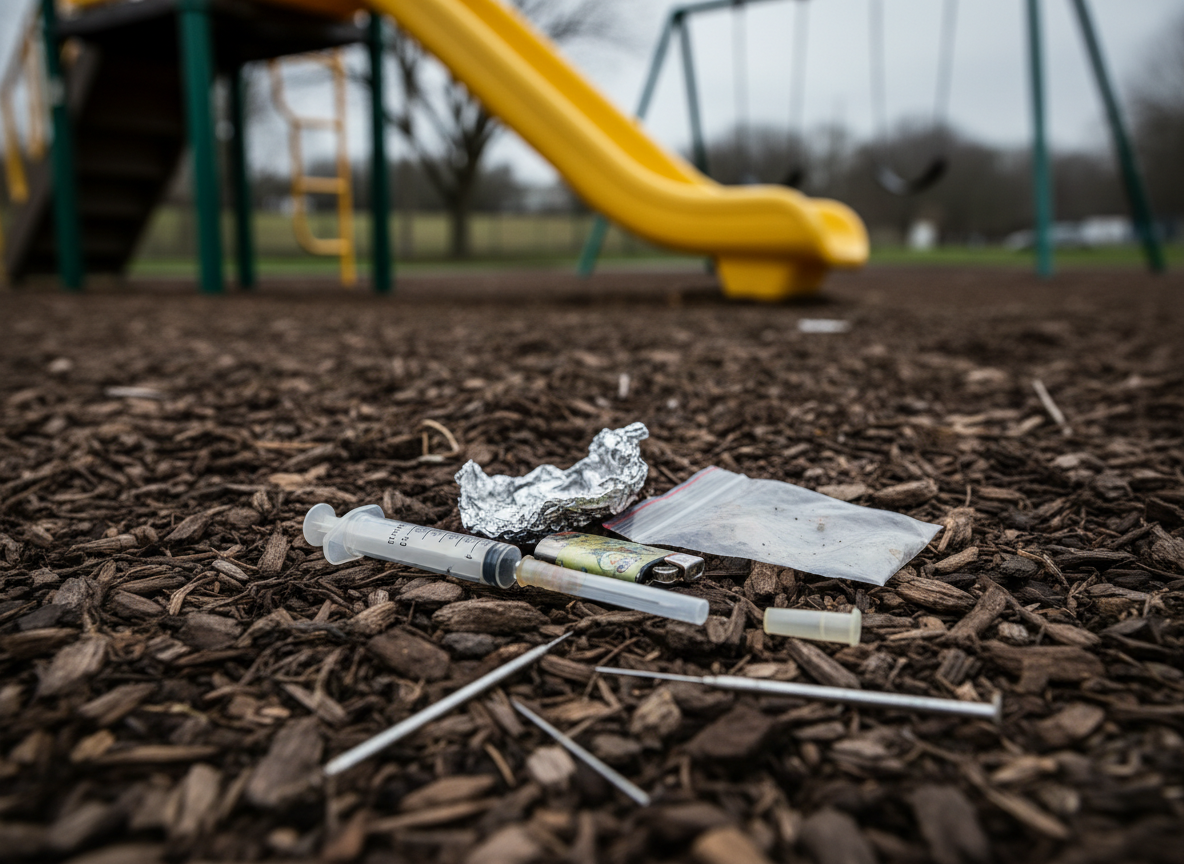
Sharps and Injection Equipment – Discarded needles and syringes present immediate puncture and bloodborne pathogen transmission risks – Glass pipes and broken paraphernalia create laceration hazards – Contaminated materials may be concealed in mulch, sand, or equipment crevices
Secondary Contamination – Body fluids on equipment surfaces or ground coverings – Drug residue on play surfaces accessible to young children – Contaminated organic surfacing materials (woodchip, mulch)
Behavioural Hazards – Intoxicated individuals occupying play spaces during operational hours – Aggressive or unpredictable behaviour near children – Presence of drug transactions creating unsafe environments
A 2019 study by the Australian Institute of Criminology examining crime in public spaces noted that visible drug paraphernalia significantly increases community fear and reduces legitimate use of public facilities, creating a cycle of decreased natural surveillance and increased antisocial behaviour (AIC, 2019).
Work Health and Safety Obligations for Operators
The PSIA training manual dedicates substantial content to operator instructions and Work Health and Safety (WHS) compliance. Drug contamination directly triggers WHS obligations under Australian legislation.
Duty of Care Requirements
Under the Work Health and Safety Act 2011 (Cth), facility operators must: – Identify reasonably foreseeable hazards, including drug contamination – Implement control measures to eliminate or minimise risks – Provide appropriate training and personal protective equipment (PPE) to staff – Maintain incident reporting and response protocols
Safe Work Australia guidelines specify that workers encountering sharps or drug paraphernalia require specific training in bloodborne pathogen risks and proper disposal procedures (Safe Work Australia, 2022).
Inspection Protocol Modifications
Standard playground inspection checklists must be supplemented with drug contamination assessment protocols: – Visual scanning of high-risk concealment areas (under equipment, in mulch, behind structures) – Inspection of secluded zones (behind shade structures, in vegetation buffers) – Assessment of sightline obstructions that enable concealed drug use – Documentation of contamination patterns to inform design modifications
The Victorian guidelines for safer skateparks recommend daily visual inspections specifically targeting drug paraphernalia and antisocial behaviour evidence, separate from equipment safety checks (Crime Prevention Victoria, 2021).
Risk Management Strategies: Prevention and Response
Effective management requires integrated strategies addressing both prevention and response protocols.
Environmental Design Interventions
Crime Prevention Through Environmental Design (CPTED) principles offer evidence-based approaches:
Natural Surveillance Enhancement – Remove visual obstructions (dense vegetation, solid fence panels) – Install appropriate lighting for extended-use facilities like skateparks – Position equipment to maximise sightlines from surrounding areas – Consider transparent fencing materials
Territorial Reinforcement – Clear signage defining permitted hours and behaviours – Regular maintenance demonstrating active management – Community activation through programmed activities
Research published in Environment and Behavior demonstrated that parks with high maintenance standards and visible management presence experienced 73% fewer incidents of drug-related activity compared to poorly maintained facilities (Kuo & Sullivan, 2001).
Operational Response Protocols
The National Recreation and Park Association’s comprehensive response framework for substance use in parks recommends structured protocols for Australian contexts (NRPA, 2018):
- Immediate Response Procedures
- Staff training in safe sharps handling and disposal
- Provision of puncture-resistant containers and appropriate PPE
- Clear escalation pathways for situations requiring police or emergency services
- Partnership Development
- Collaboration with local police for regular patrols
- Engagement with community health services for harm reduction programs
- Coordination with local government waste management for safe disposal infrastructure
- Documentation and Analysis
- Systematic recording of contamination incidents (location, time, type)
- Pattern analysis to identify high-risk periods and locations
- Use of data to inform design modifications and patrol scheduling
Signage and Communication Strategies
The PSIA training manual includes signage as a distinct safety component. Drug-related signage serves multiple functions:
Regulatory Signage – Clear prohibition of drug use and alcohol consumption – Specification of facility operating hours – Contact information for reporting concerns
Harm Reduction Signage – Location information for nearby sharps disposal facilities – Emergency contact numbers prominently displayed – Multilingual messaging in diverse communities
Melbourne City Council’s skatepark management approach includes explicit drug and alcohol-free signage combined with information about support services, balancing enforcement with harm reduction principles (City of Melbourne, 2024).
The Skatepark-Specific Challenge
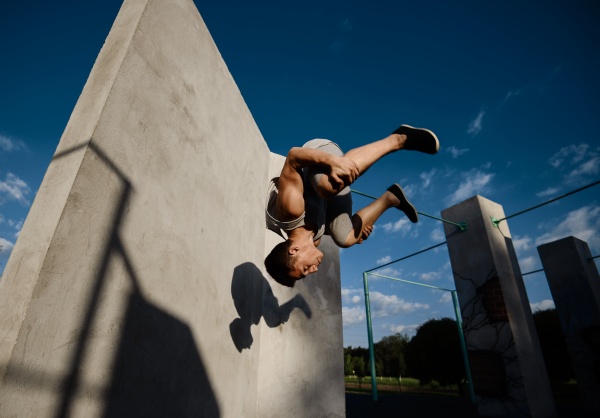
Skateparks present unique management complexities. These facilities: – Operate during extended hours (often dawn to dusk) – Attract older youth and adult users – Feature architectural elements (bowls, ramps) that create concealed spaces – Develop strong user communities that may tolerate or exclude certain behaviours
The Safety Grind guidelines emphasise community engagement as essential for effective skatepark management. Facilities with active user groups and programmed activities demonstrate significantly lower rates of antisocial behaviour, including drug use (Crime Prevention Victoria, 2021).
Victorian legislation now prohibits smoking and vaping within 10 metres of skateparks, recognising these spaces as child-frequented environments requiring enhanced protection (Health Victoria, 2023).
Discussion Point: Whose Responsibility Is Community Safety?
Playground safety inspectors certify equipment compliance against Australian Standards. Facility operators manage day-to-day operations and maintenance. Local councils develop policies and allocate resources. Police respond to criminal activity. Health services address addiction and harm reduction.
Yet drug contamination in play spaces falls into the gaps between these responsibilities. When a certified inspector identifies drug paraphernalia during an annual audit, what is their obligation? When maintenance staff encounter needles weekly, at what point does this become a design failure rather than an operational issue?
Should Australian Standards for playground and skatepark design explicitly address CPTED principles and drug-use deterrence, or does this remain solely an operational management concern?
Key Takeaways for Facility Managers and Inspectors
- Drug contamination represents a legitimate workplace health and safety hazard requiring specific protocols
- Hazard identification training must extend beyond equipment compliance to include drug-related risks
- Environmental design modifications can significantly reduce drug-related activity in play spaces
- Effective management requires partnerships across council departments, police, and health services
- Documentation and pattern analysis inform evidence-based interventions
- Skatepark facilities require enhanced management strategies due to extended hours and user demographics
References:
Australian Institute of Criminology (2019). Crime and Safety in Public Spaces. Canberra: AIC.
City of Melbourne (2024). Skateboarding in Melbourne: Facility Management Guidelines. Melbourne: City of Melbourne.
Crime Prevention Victoria (2021). The Safety Grind: Guidelines for Safer Skate Parks. Melbourne: Department of Justice and Community Safety.
Dovey, K., Fitzgerald, J., & Choi, Y. (2001). Safety becomes danger: Dilemmas of drug-use in public space. Health & Place, 7(4), 319-331.
Health Victoria (2023). Skate Parks: Smoke-Free and Vape-Free. Melbourne: Victorian Department of Health.
Kuo, F.E., & Sullivan, W.C. (2001). Environment and crime in the inner city: Does vegetation reduce crime? Environment and Behavior, 33(3), 343-367.
National Recreation and Park Association (2018). A Comprehensive Response to the Substance Use Crisis in Parks and Recreation. Ashburn, VA: NRPA.
Safe Work Australia (2022). Managing Sharps in the Workplace: Code of Practice. Canberra: Safe Work Australia.
Ti, L., Tobias, S., Lysyshyn, M., Laing, R., Nosova, E., Choi, J., Lockie, S., Shapiro, A.M., Lamb, C., Karamouzian, M., & Hayashi, K. (2023). A scoping review of needle debris and discarded drug paraphernalia in community settings. International Journal of Drug Policy, 121, 104195.
Work Health and Safety Act 2011 (Cth).
Playground Safety Inspectors Australia provides comprehensive training in hazard identification, risk management, and operator obligations. Our courses equip facility managers and inspectors with the knowledge to address both traditional equipment safety and emerging operational challenges.