
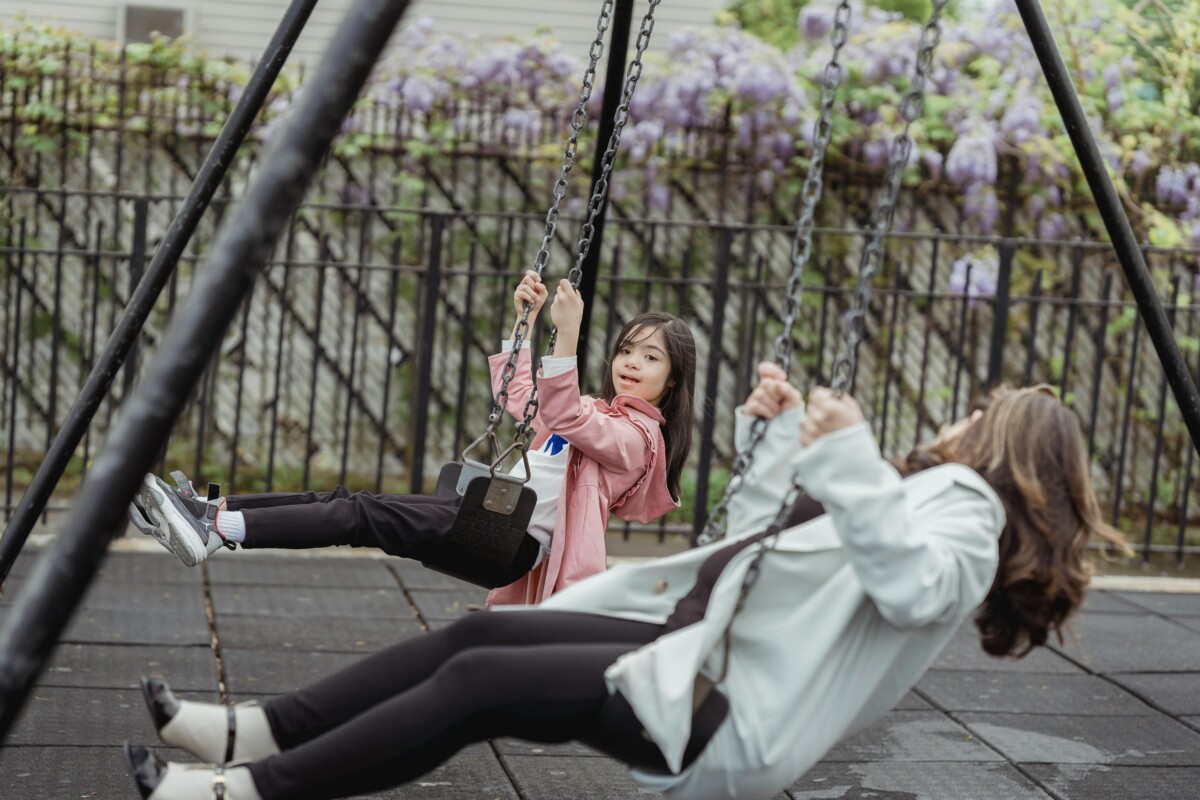
The Hidden Hazards in Swing Design: Why Equipment-Specific Standards MatterChildren on playground swings
Swings are the most recognisable piece of playground equipment worldwide, yet they consistently rank among the highest contributors to playground injuries. According to the Royal Children’s Hospital Melbourne, swings account for approximately 20% of all playground-related injuries presenting to emergency departments across Australia (Royal Children’s Hospital Melbourne, 2023).
Why Swings Require Specialised Safety Standards
The Australian Standard AS 4685.1:2021 dedicates an entire section to swing-specific requirements, and for good reason. Unlike static equipment, swings introduce dynamic forces, predictable motion patterns, and unique entrapment risks that demand specialised design considerations.
Critical Design Elements Often Overlooked
Swing Seat Design and Material Selection
The type of swing seat directly impacts injury severity. Research published in the Journal of Pediatric Orthopaedics found that rigid swing seats (timber or metal) resulted in significantly higher injury severity scores compared to flexible materials when impact occurred (Mowat et al., 2007). This evidence underpins Australian Standard requirements for swing seat specifications, including:
- Maximum mass requirements to reduce impact force
- Edge radius specifications to minimise laceration risk
- Material flexibility standards to absorb impact energy
- Spatial Requirements: The Use Zone Misconception
Many facility managers misunderstand swing use zones. The Australian Standard AS 4685.1 specifies that swing use zones must extend a minimum distance calculated from the pivot point, not the frame structure. A study by the Consumer Product Safety Commission (USA) demonstrated that 65% of swing-related injuries occurred within the designated use zone when spatial requirements were incorrectly calculated or when equipment was improperly spaced (CPSC, 2019).
The Entrapment Risk Factor
Swing suspension systems present unique entrapment hazards. Chain links, S-hooks, and connection points must meet strict dimensional requirements outlined in AS 4685.1. The standard specifies:
- Maximum opening dimensions for chain links (prevents finger entrapment)
- S-hook closure requirements (prevents clothing entanglement)
- Bearing housing specifications (eliminates shearing points)
Research from the Queensland Injury Surveillance Unit identified that entrapment injuries, whilst less frequent than impact injuries, resulted in longer hospital stays and more complex treatment protocols (QISU, 2018).
Manufacturer Compliance: Beyond the Compliance Plate
A compliance plate doesn’t guarantee ongoing safety. The Playground Safety Inspectors Australia training manual emphasises that inspectors must verify:
- Installation compliance – Was the equipment installed according to manufacturer specifications?
- Maintenance adherence – Are manufacturer-recommended maintenance schedules being followed?
- Modification documentation – Have any post-installation modifications compromised original design safety features?
The Victorian Building Authority reported that 43% of playground equipment failures investigated between 2019-2022 involved swings where installation deviated from manufacturer instructions (VBA, 2022).
The Role of Regular Inspections
Swings experience continuous dynamic loading, leading to accelerated wear at critical connection points. The Australian Standard AS 4685.0 recommends:
- Daily visual inspections – Checking for obvious hazards (broken seats, exposed hardware)
- Monthly operational inspections – Testing swing movement, checking wear patterns
- Annual comprehensive inspections – Conducted by certified playground safety inspectors
A longitudinal study tracking 200 playgrounds across New South Wales found that facilities with documented monthly inspection protocols experienced 67% fewer reportable swing-related incidents compared to facilities conducting only annual inspections (NSW Department of Education, 2021).
Discussion: Are We Designing for Real-World Use?
Standards provide minimum safety requirements, but do they account for evolving play behaviours? Modern playground users engage in activities designers never anticipated – tandem swinging, standing whilst swinging, and using swings as launching platforms.
Should Australian Standards evolve to address these observed behaviours, or should operator management strategies focus on behaviour modification through signage and supervision?
Key Takeaways for Facility Managers
- Swing-specific standards exist because swings present unique hazard profiles
- Compliance plates verify manufacturing standards, not installation or maintenance quality
- Regular inspections by certified professionals identify wear patterns before failure occurs
- Understanding equipment-specific requirements protects both users and operators from liability
References:
Consumer Product Safety Commission (2019). Playground Equipment-Related Injuries. Washington, DC: CPSC.
Mowat, D.L., Wang, F., Pickett, W., & Brison, R.J. (2007). A case-control study of risk factors for playground injuries among children in Kingston and area. Injury Prevention, 4(1), 39-43.
NSW Department of Education (2021). Playground Safety Management: A Five-Year Review. Sydney: NSW DoE.
Queensland Injury Surveillance Unit (2018). Playground Injury Data Analysis 2013-2018. Brisbane: QISU.
Royal Children’s Hospital Melbourne (2023). Playground Safety Statistics. Melbourne: RCH National Child Health Poll.
Standards Australia (2021). AS 4685.1:2021 Playground equipment and surfacing – Part 1: General safety requirements and test methods. Sydney: Standards Australia.
Victorian Building Authority (2022). Playground Equipment Compliance Investigation Report. Melbourne: VBA.
Want to ensure your playground swings meet current Australian Standards? Contact Playground Safety Inspectors Australia for certified inspection services and comprehensive training programs.