
The Transformative Benefits of Parkour: Building Confidence and Capability in Young Athletes
Parkour has emerged as one of the most dynamic physical disciplines for youth development, attracting participants aged 8 and above. According to AS EN 16899:2020, the standard specifies requirements for parkour equipment “for use mainly by users starting from 8 years of age.” This movement practice combines athleticism, problem-solving, and mental resilience – delivering measurable results that are transforming lives worldwide.
What is Parkour?
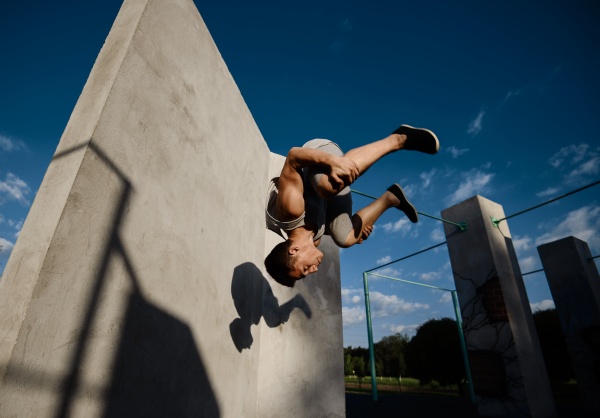
According to AS EN 16899:2020 and Safety Guide written by Lynnel Crockart – Playground Safety Inspectors Australia, parkour is defined as: “the non-competitive sport of training to move freely over and through a terrain using only the abilities of the body, principally through running, jumping, climbing and quadrupedal movement.” The sport emphasises functional strength, balance, spatial awareness, agility, coordination, precision, and creative vision.
The Philosophy Behind Parkour
Your training manual emphasises that parkour “aims to build confidence determination, self-discipline and self-reliance, and responsibility for one’s actions. It encourages humility, respect for others and for one’s environment, self-expression, and community spirit, and always emphasises the importance of discovery and safety.”
Age-Specific Development Benefits
Children (8-12 years): Parkour builds fundamental motor skills, spatial awareness, and coordination. Young practitioners develop confidence in their bodies while learning risk assessment in controlled environments. The discipline teaches self-improvement and reveals physical and mental limits while offering ways to overcome them.
Teens (13-18 years): This age group experiences the most dramatic transformations. Parkour develops strength, flexibility, and explosive power while fostering problem-solving skills and emotional resilience. Teens gain a sense of achievement through progressive skill mastery and learn to embrace challenge as a pathway to growth.
Young Adults (18-25+ years): Parkour becomes a tool for stress management, community building, and personal challenge. Many discover it as a lifelong practice for maintaining fitness and mental clarity.
Key Development & Health Results
Physical Fitness: Parkour builds functional strength, cardiovascular endurance, and flexibility. The sport focuses on “developing the fundamental attributes required for such movement, which include functional strength and fitness, balance, spatial awareness, agility, coordination, precision, control, and creative vision.”
Confidence & Self-Efficacy: Participants consistently report increased self-confidence as they overcome fears and master new skills. The sport is designed to reveal one’s physical and mental limits while simultaneously offering ways to overcome them.
Problem-Solving: The discipline trains the brain to assess environments creatively and find efficient solutions—skills that transfer to academic and professional life. Parkour emphasizes “flow,” defined as moving “smoothly with unbroken continuity” through varied terrain.
Mental Resilience: Learning to fail safely and recover builds psychological toughness and growth mindset. The sport encourages “self-improvement on all levels” and fosters “determination, self-discipline and self-reliance.”
Community & Belonging: Parkour communities are welcoming and supportive, providing social connection and motivation.
Global Safety Record
Contrary to popular perception, parkour has a strong safety record when practiced properly. According to research (references available via our Safety Guide): “According to research, parkour is safer than a sport like soccer or basketball.” The manual also notes: “Deaths and injuries in Parkour are rare. Statistically, they are too low to count.”
Importantly, the documented parkour-related incidents have not been associated with designed or manufactured parkour equipment in public spaces, but rather with uncontrolled urban environments or unsupervised high-risk activities.
Safety Standards & Compliance
The development of AS EN 16899:2020 reflects the sport’s maturation and the industry’s commitment to participant safety. The safety guide explains: “The widespread adoption of parkour and the establishment of dedicated training facilities highlighted the need for standardised safety regulations.”
- The standard specifies comprehensive requirements across multiple dimensions: Materials and Structural Integrity: Ensures equipment durability and safety through proper material selection and structural testing.
- Safety Requirements: Addresses sporting ability access, entrapment prevention, and protection against injuries. For example, Clause 5.1 specifies that “Access to equipment shall be possible only through the user’s own sporting ability,” allowing users to develop skills progressively.
- Dimensions: Establishes maximum heights, falling spaces, and landing requirements. Clause 6.4 specifies that “The maximum free height of fall to impact area shall not exceed 3 000 mm.”
- Installation, Inspection & Maintenance: Requires competent persons to conduct routine visual inspections, operational inspections (every 1-3 months), and annual main inspections to ensure ongoing safety.
Why Parkour Stands Out
Unlike traditional sports with rigid rules, parkour celebrates individual expression and progression. “It is a sport that encourages self-improvement on all levels, revealing one’s physical and mental limits, while simultaneously offering ways to overcome them.”
There’s no competition against others, only personal growth. This inclusive approach means everyone, regardless of athletic background, can participate and succeed. The emphasis on “discovery and safety” ensures that practitioners develop skills responsibly while building genuine confidence.
Getting Started Safely
If you’re considering introducing parkour sites or assisting in their operation for your community, seek out certified Trainers who emphasise safety, proper progression, and the philosophy of respect and discipline. Quality and comprehensive courses delivered by Qualified Trainer and Assessors referencing the AS EN 16899:2020 Standards ensures participants develop skills safely while building the confidence that makes parkour truly transformative.
Organisations like Playground Safety Inspectors Australia (PSIA) provide the only Worldwide available comprehensive training for safety essentials and Certification for inspectors to ensure parkour facilities meet the highest safety standards, allowing young people and adults to experience the full benefits of this dynamic sport.